
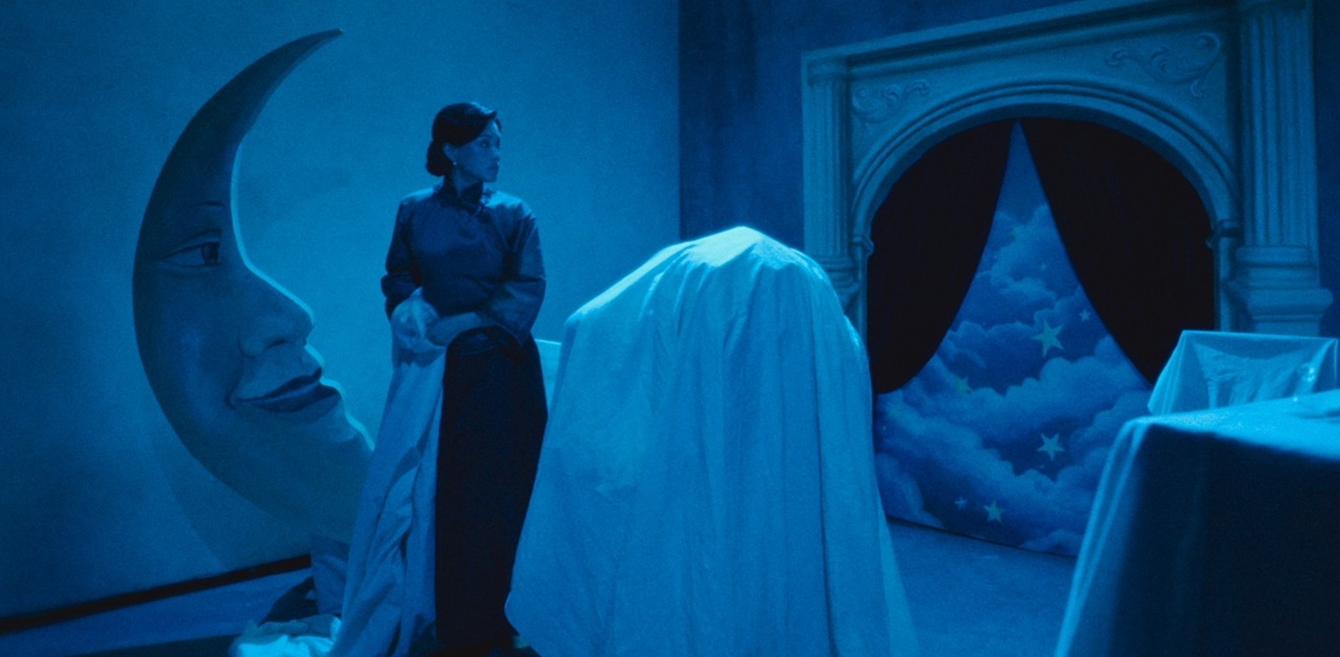
A ring of fire burns a hole in the center of the black screen. On the other side, viewers in an early twentieth-century movie theater return the camera’s gaze without any embarrassment. The burning fourth wall allows the film to observe us, just as we observe it. Bi Gan declares from the outset the rules of the metafictional game we are about to enter, and in this sense, “Resurrection” is transparent in its turbidity. The six episodes that comprise it have at least three main levels of interpretation.
The first recalls the Buddhist theory of consciousness, which recognizes six senses—sight, hearing, taste, smell, touch, mind/memory—in a context of mutual, dynamic interpenetration of all events and processes in the cosmos. The second recalls contemporary Chinese history, captured at various crucial junctures of the past century: the translation of the original title sounds like “crazy times” (狂野时代). The third recalls the history of cinema, taking the form of a poetic manifesto by the author who aims to pay homage to and transcend the reference models.

